

Le corps est conçu pour répondre à la charge
Chaque mouvement soumet le corps à des contraintes mécaniques. L'entraînement, le renforcement musculaire, le sport, la rééducation et les activités quotidiennes créent tous des stimuli mécaniques. Par un processus appelé mécanotransduction, les cellules détectent ces forces et les traduisent en signaux biologiques qui influencent le remodelage et l'adaptation des tissus.
C’est le point de départ du cadre de la Performance Continuity :
La charge mécanique crée le stimulus.
Le corps génère la réponse.
Lorsque ce processus se répète dans des conditions appropriées, le corps développe progressivement sa capacité à répondre aux sollicitations physiques. Chez Laimée, nous appelons cette capacité à maintenir ce processus dans le temps la Performance Continuity.
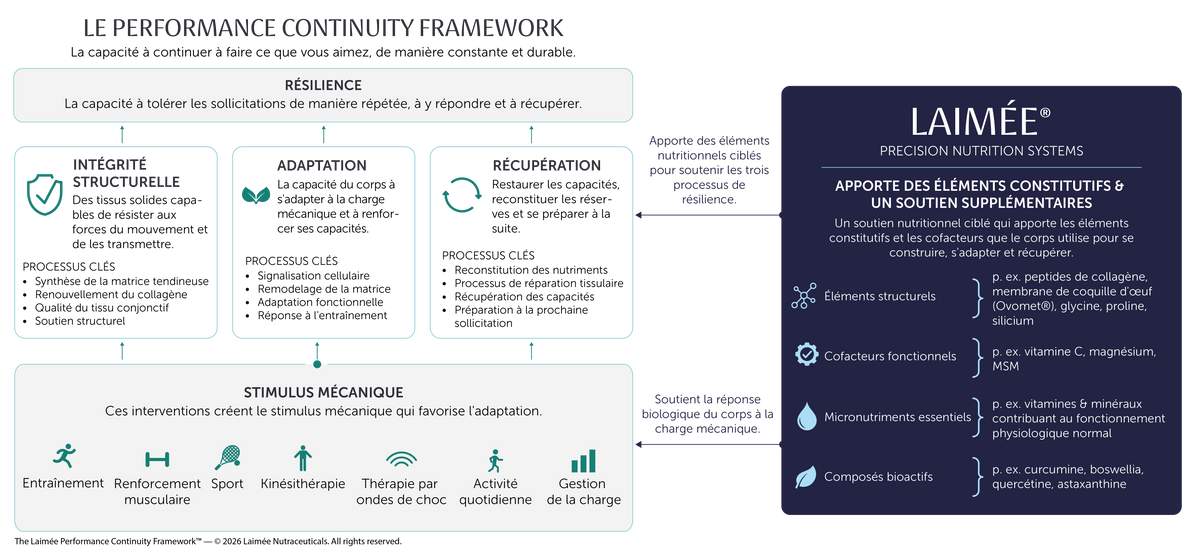
From stimulus to resilience
The body's response to mechanical loading relies on three interconnected processes:
Structural Integrity — maintaining tissues capable of withstanding and transmitting mechanical forces.
Adaptation — translating mechanical loading into cellular signalling, tissue remodelling and increased functional capacity.
Recovery — restoring capacity and preparing the body for what comes next.
Together, these processes build resilience: the ability to repeatedly tolerate, respond and recover. Resilience is what allows the cycle to continue — stimulus after stimulus, session after session.
When load exceeds capacity
Adaptation depends on the balance between mechanical demand and the body's current capacity to respond and recover. When load is appropriately dosed, tissues can adapt and progressively build capacity. But when repeated mechanical demand exceeds that capacity — and adaptation and recovery cannot keep pace — the balance can become disrupted.
Over time, this may be associated with reduced tissue load tolerance, increased sensitivity and changes in tendon structure and function. At the elbow, this can present as conditions such as tennis elbow or golfer's elbow.
In simple terms:
Repeated Load > Current Capacity
Once Performance Continuity is disrupted, the objective is not simply to eliminate load. It is to progressively restore the body's capacity to tolerate it again. Load management, progressive strengthening and rehabilitation are therefore central to the process. But rebuilding capacity is not purely mechanical. It is biological — and biology requires nutrition.
The Nutritional Layer: Where Laimée Adds Value
Mechanical loading provides the signal for adaptation. What happens after that stimulus depends on the body's biological response. That response involves tissue turnover, remodelling, recovery and normal physiological processes — all of which rely on nutritional substrates and cofactors. This is where Laimée adds a targeted nutritional layer.
Our Precision Nutrition Systems provide targeted combinations across four complementary nutritional dimensions:
Structural Building Blocks: Nutritional substrates such as collagen peptides, glycine, proline and eggshell membrane.
Functional Cofactors: Nutrients involved in key physiological processes, including vitamin C and magnesium.
Essential Micronutrients: Vitamins and minerals supporting normal physiological function.
Selected Bioactive Compounds: Compounds such as curcumin, boswellia, quercetin and astaxanthin, selected for targeted nutritional support during periods of physical demand.
Laimée focuses on what happens after the stimulus — providing selected nutritional building blocks and cofactors during a period in which the body is repeatedly being asked to remodel, recover and adapt.
Making Every Stimulus Count
When rebuilding capacity, the quality of each stimulus matters. Because when performance is interrupted, time matters. This is where Laimée brings greater efficiency to the Performance Continuity Framework. Training and rehabilitation determine the quality of the mechanical stimulus. Laimée adds the nutritional dimension, with the aim of creating an optimal nutritional environment for the body to respond to each stimulus. Laimée supports those biological processes with targeted nutritional support tailored to the specific needs of each stage.